
Two stability plans can both be described as testing and still be buying completely different things. A lean screening protocol tells you which candidate formula is likely to survive and should be developed further. A full qualification programme tells a retailer, an importer and a safety assessor that a specific product in a specific pack has been studied under defined conditions for a defined period. Choosing between them is not a question of rigour; it is a question of what the launch has to prove and to whom. Most travel retail projects end up running the first early and the second on the combinations that will actually be sold.
Key takeaways
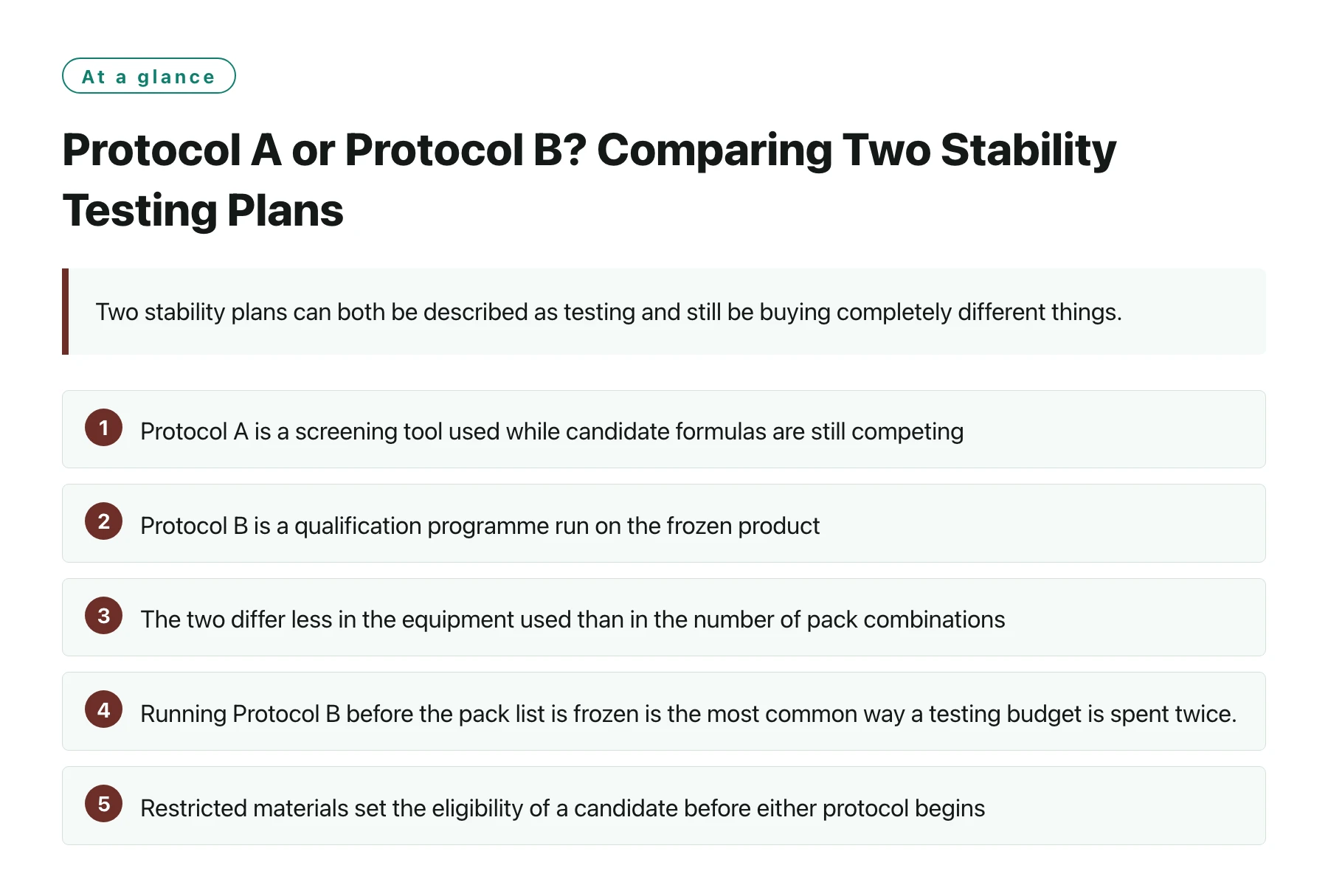
- Protocol A is a screening tool used while candidate formulas are still competing, and its output is a ranking rather than a claim.
- Protocol B is a qualification programme run on the frozen product, and its output is evidence attached to a pack, a claim and a market.
- The two differ less in the equipment used than in the number of pack combinations, the duration, the documentation and who is entitled to rely on the result.
- Running Protocol B before the pack list is frozen is the most common way a testing budget is spent twice.
- Restricted materials set the eligibility of a candidate before either protocol begins, because a material that cannot be used at the required level in the intended category is not a candidate [1].
- A qualification result is only as portable as its documentation, since the parties who rely on it were not present when the work was done [2].
Buyers often meet this choice as a price difference. One supplier quotes a compact programme, another quotes something several times larger, and the instinct is to ask which one is necessary. The honest answer is that they are not substitutes. A screening protocol is purchased to make a development decision. A qualification programme is purchased to support a claim and to survive external scrutiny.
Framing the decision that way tends to resolve most of the argument. If the formula is still moving, the larger programme will produce results for a product that will not exist. If the formula and pack are frozen and a retailer is waiting, a screening round will not answer the question being asked.
The comparison below sets the two side by side, and then describes the hybrid that most launches actually run.
Protocol A and Protocol B side by side
| Dimension | Protocol A: lean screening | Protocol B: full qualification |
|---|---|---|
| Timing | During development, while several candidates are still in play | After the formula and the pack list are frozen |
| Combinations covered | Usually one reference pack, or a small representative set | Every combination that will be sold, grouped only where materials are genuinely equivalent |
| Conditions | Accelerated temperature, sometimes a single cycling pass | Accelerated, cycling, light exposure where relevant, and real time over the claimed period |
| Duration | Weeks, enough to eliminate weak options | The full claimed period for real-time data, alongside earlier checkpoints |
| Units tested | Small numbers, often laboratory-filled | Production-representative units in the production pack |
| Who runs it | The manufacturer's own laboratory is usually sufficient | Internal work plus independent verification for the release-critical items [3] |
| Output | A ranking that supports a development decision | Reports that support artwork claims, a safety assessment and a retailer's questions |
| Failure mode if used wrongly | Being quoted as evidence for a claim it was never designed to support | Being run too early, so the results describe a pack or formula that then changes |
The last row explains why the argument is rarely about which protocol is better. Each has a failure mode, and each failure mode is a timing error rather than a technical one.
How to choose without paying twice
The decision has three inputs: how settled the formula is, how many packs will be sold, and what has to be claimed. A project with one frozen formula in one pack and a modest claim needs a much smaller programme than a range of four formats across decorated glass, plastic and a pump, and it needs less documentation because fewer parties will ask for it.
A useful discipline is to write the claim on a piece of paper before requesting either protocol. If the artwork will say three years, the real-time commitment exists whether or not it is written into the quote; the only question is whether it is planned or discovered later. If the artwork will say twenty-four months, the programme should be judged against that and not against a longer study nobody needs.
Documentation follows the same logic. A retailer, an importer or a safety assessor will rely on the results without having been present, so the record has to stand alone and name its own conditions [2]. Industry guidance on good manufacturing practice makes the same point in a broader way: the system depends on records that a third party can follow [4].
The hybrid most launches run
In practice the two protocols are used in sequence. A screening round removes candidates that cannot take the exposure the channel implies, which is cheap and fast. Once the winner and its packs are fixed, the qualification programme runs on the real combinations, and the screening data is retained as development history rather than presented as qualification evidence.
This sequencing is also the most economical, because it avoids running long studies on options that will be discarded. The trap is to run the screening round, approve the scent, and then treat the study as finished, which leaves the launch with development data and a claim that needs more.
Questions that reveal which protocol is being quoted
Ask how many combinations are covered, which conditions are used, how long the study runs, whether the units are production-representative, and whether any part of the work is verified independently. Those five answers distinguish the protocols more reliably than the price does. A quote that cannot answer them is not yet a protocol, whichever label it carries.
What both protocols assume
Neither protocol rescues a brief that has not been settled. Both assume a fixed pack list, a defined claim and a market list, and both assume the formula has already been screened against the material restrictions that apply to the intended product category.
That last assumption is worth checking first, because it can invalidate a candidate before any chamber time is booked. Buyers who compare partners on how early those boundary questions are raised usually find that the answer predicts how the rest of the project will go; how to compare perfume factories is essentially a comparison of which questions a partner asks before quoting.
It is also reasonable to read public material before a first conversation. A manufacturer's own description of its development and manufacturing scope, such as the Xuelei website, will not tell you which protocol your launch needs, but it will tell you whether the scope exists for testing, filling and documentation to be handled as one programme.
If only one protocol can be bought this quarter, buy the screening round and freeze the pack list while it runs. A qualification programme purchased against a moving specification is the single most expensive way to buy testing, because the results are invalidated by the next decision. The reverse order costs very little and keeps both options open.
Sources
- IFRA Standards Library (International Fragrance Association) —— The IFRA Standards Library lists the restrictions the fragrance industry applies to individual fragrance ingredients, based on safety assessments; it is the reference point for compliant fragrance formulation.
- EU Scientific Committee on Consumer Safety (SCCS) —— The EU scientific committee that issues opinions on the safety of cosmetic ingredients, including fragrance allergens and their labelling thresholds.
- SGS: Cosmetics, Personal Care & Household Testing —— Testing, inspection and certification services for cosmetics and personal care, including microbiological, stability and safety testing aligned with cosmetics GMP.
- Cosmetics Europe —— The European trade association for the cosmetics and personal care industry, publishing guidance, positions and market information.
Frequently asked questions
Can a screening protocol be used as evidence for a shelf-life claim?
Generally no. Screening results come from a limited set of combinations and typically from accelerated conditions alone, and they are produced to support a development decision. A claim on packaging is supported by qualification work on the frozen product in its pack, including real-time data over the claimed period.
How many pack combinations should the qualification programme cover?
Every combination that will be sold, with genuinely equivalent combinations grouped. Two bottle sizes in the same glass with the same pump may be treated as one question; a plastic travel vial, a refillable case and a pressurized sprayer are separate ones. Grouping decisions are worth recording, since they will be revisited if a component changes.
Is independent laboratory verification required for a travel retail listing?
Not always, and requirements vary by market and retailer. Many projects run routine development work in the manufacturer's laboratory and commission independent verification for the items most likely to be scrutinised. Independent testing services of the kind offered by global inspection and testing companies are one route; the important point is deciding in advance which results need that treatment.
What happens if the decoration changes after qualification?
It depends on which layer changed. A change to the juice or to a material in direct contact with it usually invalidates the relevant compatibility results. A change to an external carton may not. The practical answer is to agree in writing which changes trigger a repeat, so the question is settled once rather than argued each time a supplier substitutes a component.
Does a longer protocol guarantee a longer shelf life?
No. The programme produces evidence; the shelf life is what that evidence supports for the specific product in its specific pack under stated conditions. A longer or larger programme simply widens the range of claims that can be defended and the number of parties who can rely on the result.