
Custom Brass Jewelry for Sensitive-Skin Collections
Sensitive-skin ranges are sold on paper before they are sold on looks. The published compliance position for a plated brass line is REACH compliance on lead, cadmium and nickel, multi-layer gold or rhodium electroplating, and a protective anti-tarnish e-coating over the top — on a MOQ of 100 pieces per design for artisan eco-brass.

Key takeaways
- REACH compliance is published for lead, cadmium and nickel — the three restricted metals a jewelry buyer checks.
- Plating is the layer between the brass and the skin, in 14K, 18K or 24K gold or rhodium.
- An anti-tarnish e-coating sits over the plating on brass and silver pieces, and PVD covers stainless steel.
- A gold-plated brass piece is hallmarked 18KGP, which is the claim printed on the product itself.
What a sensitive-skin collection is really claiming
The phrase describes the buyer's experience rather than a material property, so the honest way to build one is to control what touches the skin and document it. On a plated piece there are two contact layers: the plating itself and whatever sits over it, which is the anti-tarnish e-coating on brass and silver.
The rest of the piece is behind those layers, and that is what makes plating a compliance decision rather than a colour choice. The materials statement is the document that supports the claim, and it is published as REACH compliant for lead, cadmium and nickel.
The three restricted metals in plain terms
Lead, cadmium and nickel are the three named in the published REACH statement, and the plating is separately described as compliant with REACH and California Proposition 65 standards. Written out that way, the compliance file is short and checkable.
It is also the part of a product listing that a stockist's compliance team will ask about, so keep the statement next to the hallmark set: an 18KGP mark on plated work, an S925 stamp and 316L on stainless, all applied by high-precision laser engraving. A claim about what a piece is made of should be readable on the piece.
Why plating works as the barrier on brass
Brass is a base metal, and the plating stack is multi-layer precious metal electroplating in 14K, 18K or 24K gold or rhodium. Because the layer is deposited over the whole exposed surface, the wear surface is the coating rather than the alloy underneath it.
That is also why the finish should be specified rather than assumed. Karat and colour family change what the buyer sees, but the presence of a proper multi-layer deposit is what makes the piece suitable for a range that markets itself on comfort and daily wear.
The anti-tarnish e-coating, and why it is not cosmetic
The e-coating is the topmost layer on brass and silver pieces and it protects the plating beneath it. For a sensitive-skin range that matters twice over: the coating is the surface in contact with the wearer, and it also keeps the finish from dulling in storage between production and sale.
Stainless steel follows a different route entirely, with PVD vacuum plating rather than electroplating plus e-coating. If a range spans both materials, the two wear surfaces are not the same product experience and should be described separately.
What belongs on the product page
Write the base material, the plating route and the hallmark. Add the REACH statement as a materials claim, and keep the wording to what is documented rather than what a customer might hope is true. Nothing on a plated piece needs to be described as a medical benefit, and it should not be.
Back it with the two production documents that make the claim real: the inspection record showing the pieces were checked before packing, and the quality management system, documented to ISO 9001:2015, that keeps the process repeatable from batch to batch.
Minimums and how a range is planned
Entry quantities are 100 units in the eco-brass line, 100 plus in stainless steel and 50 in the silver line, design by design. A sensitive-skin range usually starts narrow: one or, which a second design simply doublesthe sell-through is known.
That restraint is not only about cash. Every additional plating colour or stone option adds a specification that has to be documented and checked, and the compliance work behind the range is per design per material rather than per piece.
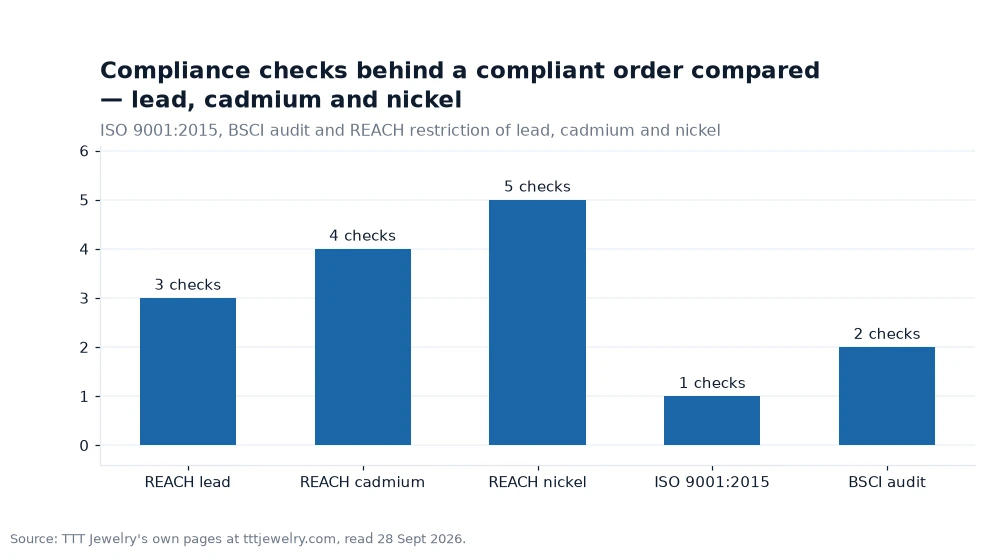
| Check | What it covers | Published position |
|---|---|---|
| REACH lead | Base material and plating | Compliant, lead restricted |
| REACH cadmium | Base material and plating | Compliant, cadmium restricted |
| REACH nickel | Base material and plating | Compliant, nickel restricted |
| ISO 9001:2015 | Quality management across production | Implemented at all production stages |
| BSCI audit | Labour practices and supply chain | Audited |
What the brass line itself states about skin contact
Two sentences on the brass product page answer most of the sensitive-skin question directly. The plating layers — advanced gold and rhodium — are described as forming a durable barrier that is suitable and comfortable for most skin types, while the nickel content of the alloy is stated as meeting certified standards. The products are listed as complying with REACH and California Proposition 65.
That is the order to quote it in, because the barrier claim and the nickel statement do different jobs. The plating describes the surface a wearer touches; the nickel statement describes the alloy underneath it. A custom brass jewelry range marketed on comfort should carry both, and it should say which is which.
The same page adds a finish option worth knowing for heavier or more traditional designs: oxidation and antique finishes, which darken recessed detail rather than brightening the whole piece. It also states that the brass is 100% recyclable — the line's own sustainability wording, and the safest one to reuse.
Worked example: amortising one compliance file over the minimum run
A materials statement, a hallmark plan and an inspection record are produced once per design per material, not once per piece. So the compliance effort per unit is the number of documents divided by the size of the run.
On a three-design brass range at the published minimum, that is 3 × 100 = 300 pieces covered by three files, or one file per 100 pieces. Reorder each design at 300 pieces and the same three files cover 3 × 300 = 900 pieces, or one file per 300.
The comparison is 1 ÷ 100 = 0.01 files per piece against 1 ÷ 300 ≈ 0.0033, which is a third of the paperwork intensity per unit. The documents do not change; only the run they cover does, which is why a first run should be kept narrow and a proven design should be ordered deeper.
Frequently asked questions
What makes a brass piece suitable for sensitive skin?
The plating and the anti-tarnish e-coating form the contact surface, and the materials are published as REACH compliant for lead, cadmium and nickel.
Which metals does the REACH statement cover?
Lead, cadmium and nickel, with the plating additionally described as compliant with REACH and California Proposition 65 standards.
How many pieces must a brass design start at?
100 Minimums run 50 in 925 silver, 100+ in stainless and 100 pcs in artisan eco-brass, counted per design, and they hold design by design.
Sourcing a plated range with the paperwork agreed first
Ask for three things in one message: the materials restriction list, the hallmark plan and the inspection record format. A supplier used to compliance-led ranges will recognise the list, which is why a wholesale brass jewelry factory is usually judged on documents before samples. If the range has to survive daily wear and water, the stainless steel alternative describes a different wear surface, and the OEM/ODM page covers how the two routes are handled together.
Everything factual here — the REACH and California Prop 65 compliance with the recyclable-brass statement and the approved-sample benchmark — comes from the factory's own site at the tttjewelry.com address (read 28 Sept 2026). The percentages quoted above belong to me rather than the client[1].